
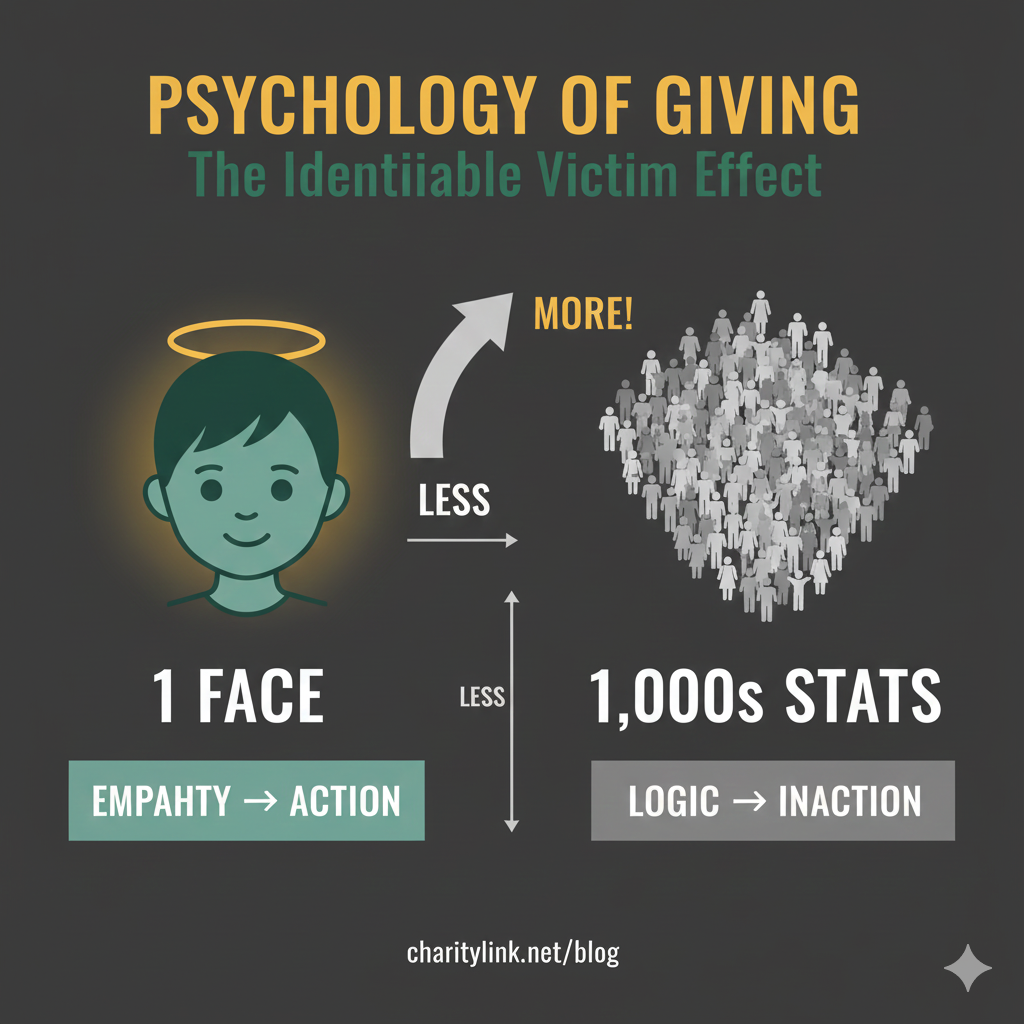
Psychology of Giving: The Identifiable Victim Effect ...
The Identifiable Victim Effect (IVE)
Why a single story drives more generosity than a thousand statistics.
Empathy Trigger
Cognitive Bias
The Data: Individual vs. Group Appeal
Classic studies demonstrate that people respond with more feeling and larger gifts when presented with an appeal focused on **one specific person** (e.g., “Rokia”) compared to an equally urgent appeal using **general statistics** (e.g., “Millions facing poverty”).
Definition of IVE:
The tendency for people to offer greater aid when a specific, identifiable person is observed to be suffering than when the victim is one of a large, anonymous group.
Simulated average gift size based on a study by Small, Loewenstein, and Slovic (2007).
The IVE Psychological Flow
The contrast is between two neural pathways: the fast, emotional System 1 (Individual) and the slow, calculating System 2 (Statistical).
STIMULUS: Single Child’s Photo/Story
STIMULUS: Millions Facing Famine (Statistics)
➜
➜
➜
⬇︎
PATHWAY A: Affective Response (Empathy, Distress)
PATHWAY B: Cognitive Response (Analysis, Calculation)
➜ PATHWAY A: **ACTION (Increased Donation)**
Pathway B often leads to **Scope Insensitivity** and feeling overwhelmed, resulting in **Inaction or Smaller Donations**.
B The Problem of Scope Insensitivity
A major consequence of IVE is that the perceived value of saving **one life** is not multiplied when the stakes increase to **two or three lives**. Donors are often ‘insensitive’ to the scope (size) of the tragedy.
The marginal value of saving additional lives rapidly diminishes in the emotional response.
E Efficacy and Control
IVE works because it gives the donor a strong sense of *efficacy*—the feeling that their specific donation **will solve that specific problem**.
-
The Drop-in-the-Bucket Effect:
When presented with 10,000 victims, a donor feels their gift is insignificant, even if it could help 10 of them. This leads to **zero giving**.
-
The Solution:
Campaigns must clearly define the *subset* of the problem the donor can solve (e.g., “Your $20 covers a week of meals for this family”).
Learn how I used this knowledge to create an AI fundraiser that can analyse an appeal and create appeal text for your letter, website, email and social using free Google tools

The Science of Giving: Bridging the Intention-Act [infographic]
The Science of Giving: Bridging the Intention-Action Gap ...