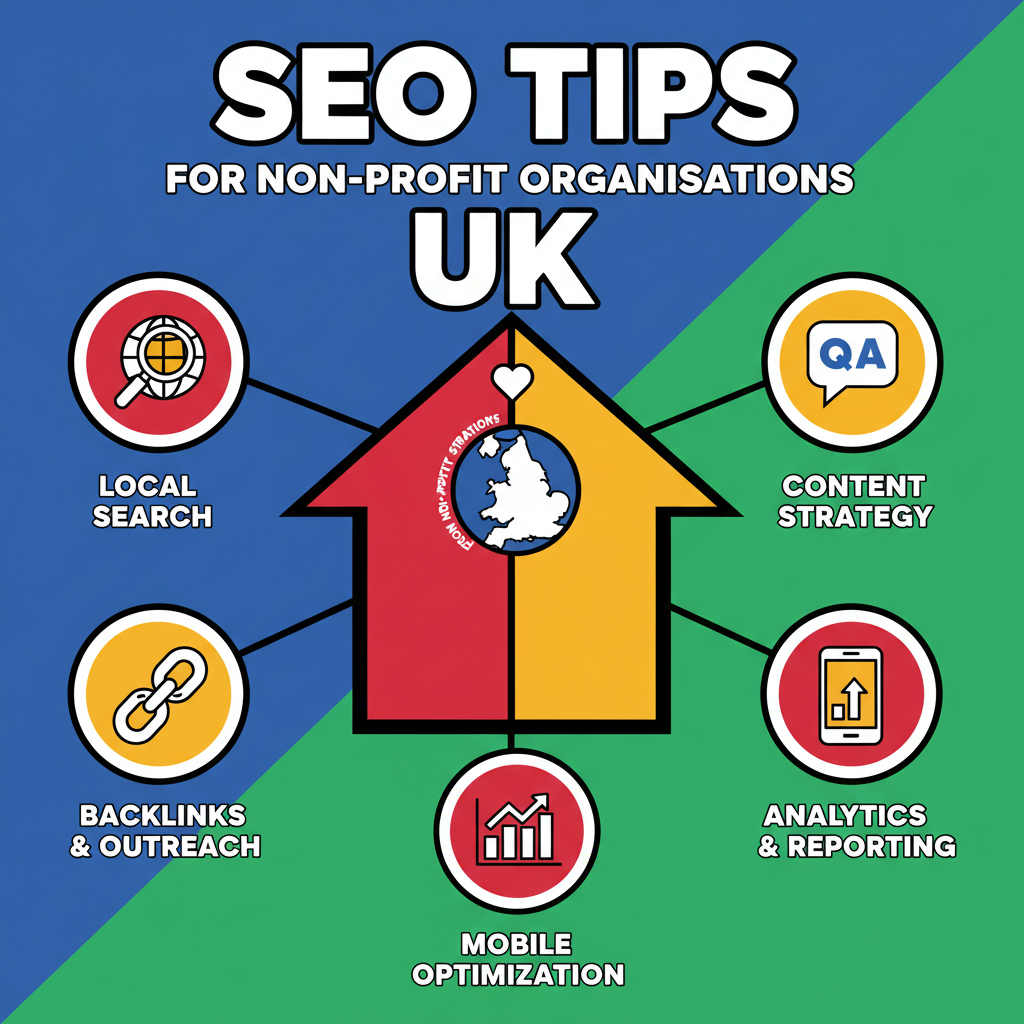

If you are a local charity use it to your advantage
The following practical guide is using an animal charity as an example so you can clearly understand the thinking when creating content and pages for your local charity website.
Running an animal charity in 2026 feels like fighting a relentless battle on two distinct fronts. On the operational side, physical shelters, foster networks, and veterinary resources are stretched to absolute capacity. On the digital side, online visibility is fiercely competitive. High-intent prospective adopters, willing volunteers, and generous local donors are actively searching for ways to help. But the critical question remains: when a user in your catchment area types “cat adoption near me” into Google, are they finding your branch, or are they being directed to a well-funded national aggregator or a commercial breeder?
The solution lies in Local Search Engine Optimisation (SEO). As a specialist Charity SEO agency UK, we know firsthand that dominating local search is the most cost-effective, sustainable methodology to drive footfall, secure monthly donations, and ultimately, clear your kennels. This comprehensive guide breaks down five actionable Local SEO tips. To provide practical context, we will use the RSPCA East Berkshire branch as a live case study, demonstrating precisely how advanced search principles apply to real-world animal welfare challenges.
Why is Local SEO crucial for animal charities?
What is local SEO for charities?
Local SEO for animal charities is the strategic practice of optimising your digital footprint to attract more high-quality traffic from relevant local searches. Unlike traditional SEO, which focuses on national or global visibility, local SEO is hyper-focused on geographic relevance. For a physical shelter or a regional rescue branch, geography is your primary ranking factor. The goal is to appear prominently in the “Local Pack”—the map-based cluster of three business listings that appears at the top of Google’s search engine results pages (SERPs) for location-based queries.
The statistics underscore the absolute urgency of this marketing channel. Recent industry data indicates that 46% of all Google searches have a specific local focus. Furthermore, with data showing that 51% of UK adults own a pet, the local audience actively seeking veterinary advice, pet adoption services, or community volunteering opportunities is vast. Capturing this engaged audience requires hyper-localised visibility. When executed correctly, local SEO significantly reduces a charity’s reliance on expensive paid social media campaigns and builds long-term, sustainable community trust. Trust, in 2026, is the cornerstone of Google’s E-E-A-T (Experience, Expertise, Authoritativeness, and Trustworthiness) algorithm.
Case Study: Overcoming Local Search Challenges at RSPCA East Berkshire
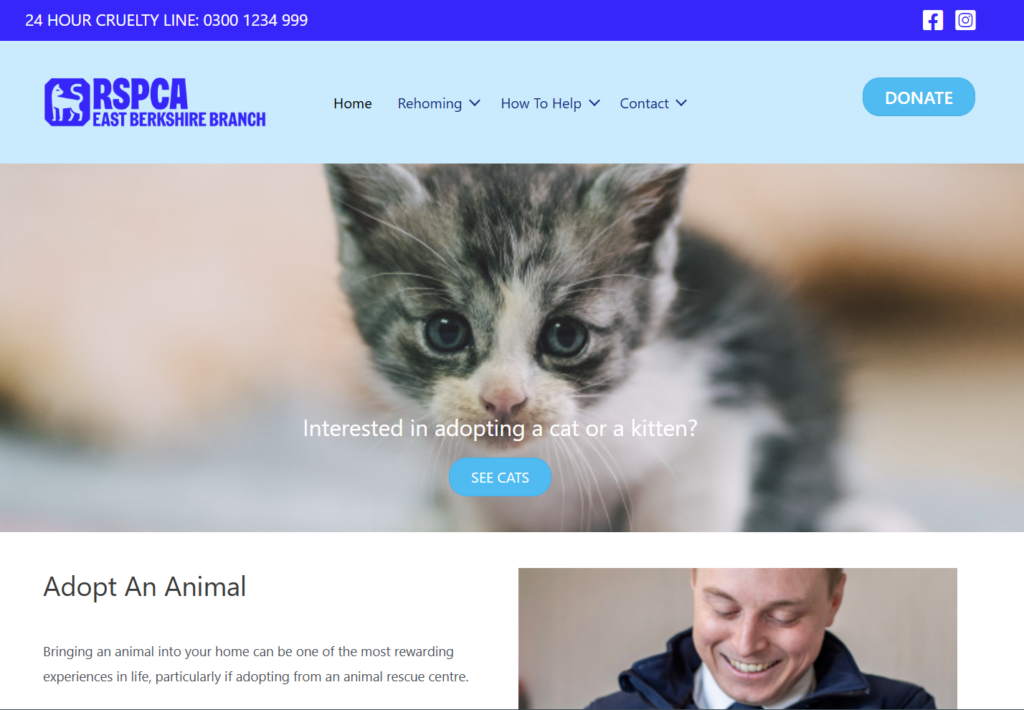
To ground these SEO strategies in reality, we will examine the RSPCA East Berkshire branch. Unlike massive national hubs with sprawling physical estates, this specific branch operates directly and intimately at the community level. According to their official reporting, the branch managed 73 successful cat adoptions in 2024. Crucially, they achieved this relying entirely on a dedicated team of 23 volunteers and 6 trustees, without the luxury of a permanent physical public centre.
Instead of operating from a central facility, the branch utilises private kennelling, a trusted cattery provider named “Joes Folly”, and a robust network of local foster homes. From an SEO perspective, this presents a unique and common challenge: how does a charity rank locally when it operates as a service-area entity rather than a fixed “shop front”? Furthermore, their Rehoming Manager recently highlighted a troubling rise in rescues from multi-cat households, a situation that compounds the urgency for fast, locally targeted adoptions to relieve pressure on their temporary boarding facilities.
Tip 1: Optimise your Google Business Profile for ‘Near Me’ Searches
How do dog rescues rank on Google?
The absolute foundation of local digital visibility is a meticulously optimised Google Business Profile (GBP). For animal charities targeting high-intent, bottom-of-the-funnel terms like “cat adoption near me”, your GBP is the primary engine driving Local Pack rankings. Google determines local rankings based on three pillars: Relevance, Distance, and Prominence. Your profile must signal all three effectively.
Because RSPCA East Berkshire operates via private boarding and foster homes rather than a public shelter, they must configure their GBP as a Service Area Business (SAB). This essential step involves hiding their physical residential addresses while explicitly defining their exact catchment area (e.g., Maidenhead, Slough, and the wider East Berkshire region). Failure to set up as an SAB when operating from residential foster homes can result in Google suspending the profile.
- Strategic Category Selection: Always choose “Animal rescue service” or “Animal protection organisation” as your primary category. Do not dilute your relevance by choosing generic “Charity” as the primary category, though it can be added as a secondary option.
- Trust-Building Attributes: Utilise GBP attributes to build immediate trust and answer preemptive questions. Add tags such as “Women-led”, “LGBTQ+ friendly”, or specify wheelchair accessibility if you hold local fundraising events in public spaces.
- Detailed Services Menus: List your specific offerings directly on the profile. For instance, clearly detailing your veterinary financial aid services ensures the profile ranks for community support and welfare queries, not just standard adoptions.
Pro-Tip: Leverage the GBP “Updates” feature to act as a micro-blog. Regularly upload high-resolution photos of available animals. Google’s Vision AI analyses image content; consistently posting clear images of rescue animals reinforces your entity’s thematic relevance to animal-related search queries.
Tip 2: Target Hyper-Local and Long-Tail Keywords
Generic keywords like “animal charity” or “rescue dogs” are far too broad, lacking specific user intent and heavily dominated by authoritative national domains. Effective SEO for dog rescues requires targeting hyper-local, long-tail keyword variations that capture users at the exact moment they are ready to act.
RSPCA East Berkshire faces a well-documented and persistent industry challenge: black cats take significantly longer to rehome. In a recent public appeal, the branch noted that black cats like Minnie, Rory, and Loki were waiting an average of 35 days for a home compared to 28 days for tabbies. This operational bottleneck can be alleviated through targeted SEO.
Instead of relying solely on a generic adopt an animal landing page, charities must create highly specific, intent-driven content silos. A dedicated page titled “Adopt a Black Cat in Maidenhead” directly intercepts local searchers with specific preferences. This approach drastically improves conversion rates.
- Map Keywords to User Intent: Understand the difference between informational queries (“how much does it cost to adopt a cat”) and transactional queries (“adopt a kitten near Maidenhead”).
- Optimise Title Tags: Ensure your title tags include the target location. For example: “Cat Rescue & Adoption in East Berkshire | RSPCA”.
- Inject LSI Keywords: Naturally weave Latent Semantic Indexing (LSI) keywords into your copy. Terms like “microchipped”, “neutered”, “home check”, and “flea treatment” signal comprehensive expertise to Google’s crawlers.
Tip 3: Leverage Volunteer and Fostering Pages for Search Intent
Local charities survive on community goodwill and operational manpower. For a regional branch heavily reliant on its 23 unpaid volunteers, recruiting reliable foster carers, fundraisers, and home checkers is just as critical as finding permanent homes for the animals. Users typing “volunteer dog walking near me” or “foster a cat in Berkshire” into a search engine are actively raising their hands to help. Your website must be ready to catch them.
Ensure your volunteering page is technically sound, emotionally engaging, and structured to convert visitors into applicants. Highlight the specific training provided to alleviate anxiety for new volunteers. For example, RSPCA East Berkshire successfully notes that volunteers interested in home checking will shadow experienced members before attending formal RSPCA training at the Millbrook Centre in Chobham. This level of detail satisfies Google’s requirement for “Helpful Content” by answering user concerns proactively.
- Clear Calls-to-Action (CTAs): Discard vague buttons like “Learn More”. Use unambiguous, action-oriented CTAs such as “Apply to Foster Today” or “Register as a Volunteer”.
- Implement FAQ Schema: Use FAQ structured data (JSON-LD) to answer common questions directly in the SERPs. Questions like “Do I need a garden to foster a dog?” or “Are vet bills covered for foster cats?” take up more visual real estate on the search results page, driving higher click-through rates.
- Embed Local Modifiers: Ensure the page text explicitly mentions the exact towns and boroughs you cover. If you desperately need volunteers in Slough, Maidenhead, or Bracknell, weave those specific locations into your semantic H2 and H3 subheadings.
Tip 4: Build Local Citations and Earn High-Authority Backlinks
Google’s E-E-A-T framework demands third-party validation to confirm that your charity is legitimate and authoritative. In the realm of local SEO, this validation comes primarily from two sources: local citations (consistent mentions of your Name, Address, and Phone Number across directories) and authoritative backlinks from trusted external websites.
For an animal charity, earning local links is often significantly easier than it is in the commercial B2B sector because the local community inherently wants to support your mission. It simply requires proactive outreach and digital PR.
- Veterinary Partnerships: RSPCA East Berkshire maintains strong partnerships with local clinics, such as Summerleaze Veterinary Clinic, who provide their default local vet care. Setting up a “Our Trusted Rescue Partners” page and engaging in a mutual link exchange passes excellent local relevance and authority.
- Digital PR and News Jacking: When a charity spokesperson speaks to the press about industry trends—such as the aforementioned crisis in multi-cat households—it presents a prime link-building opportunity. Ensure press releases always include a mandate for a “dofollow” backlink to your latest news or impact pages.
- Institutional Trust Signals: Ensure your official Charity Commission registration number is highly visible in your website’s footer. Naturally linking out to your official Charity Commission profile solidifies your organisational legitimacy in the eyes of search quality raters.
Tip 5: Maximise the Google Ad Grants for Local Reach
While this strategy guide focuses predominantly on organic local SEO, no holistic digital strategy is complete without leveraging the Google Ad Grant. Qualifying registered charities can receive up to $10,000 per month in in-kind search advertising from Google. When managed by a proficient Charity SEO agency UK, the synergy between paid ads and local organic search becomes a formidable acquisition tool.
The strategy is simple: use your Google Ad Grant to bid aggressively on highly competitive, broad terms where your organic ranking might currently be lagging (e.g., “sponsor a dog UK”), while simultaneously letting your hyper-local SEO strategy dominate the “near me” Map Pack results.
- Strict Geo-targeting: Restrict your Ad Grant campaigns strictly to your specific catchment area. Failing to geo-fence your campaigns will result in rapidly depleting your grant budget on clicks from users hundreds of miles away who cannot adopt from your local branch.
- Sitelink Extensions: Utilise ad extensions to bypass the homepage and drive traffic directly to high-priority, high-conversion initiatives, such as emergency winter appeals, urgent veterinary fundraisers, or profiles of specific hard-to-home animals.
- Compliance Management: Remember that Google Ad Grants require strict account compliance, including maintaining a minimum 5% Click-Through Rate (CTR) and avoiding single-word keywords. Aligning your paid keywords tightly with your local SEO keyword mapping ensures relevance and high quality scores.
Traditional SEO vs Local SEO for Charities
Understanding the distinction between traditional and local SEO is vital for budget allocation. Here is a quick reference comparison:
| Feature | Traditional SEO | Local SEO |
|---|---|---|
| Primary Goal | National/Global visibility and broad brand awareness. | Dominating the Local Map Pack and driving regional footfall. |
| Target Keywords | Broad terms (e.g., “animal charity”, “how to adopt a dog”). | Geo-modified terms (e.g., “cat rescue Maidenhead”, “volunteer near me”). |
| Key Ranking Factors | High-volume backlinks, domain authority, long-form content. | Google Business Profile optimisation, proximity to searcher, local citations. |
| Ideal For | National headquarters, policy lobbying, broad education. | Regional branches, physical shelters, local volunteer recruitment. |
Conclusion
Mastering Local SEO for animal charities is not simply an exercise in pleasing algorithms; it is a critical operational strategy for connecting vulnerable animals with the local humans equipped to help them. By optimising your Google Business Profile, targeting hyper-local keywords, structuring your volunteer pages for search intent, building authoritative local links, and synergising these efforts with the Google Ad Grant, your branch can achieve sustainable visibility. Taking these steps ensures that when your community searches for a way to make a difference, your charity is the first door they knock on.
Transparency & Grounding
This content was generated to strictly adhere to Google’s 2026 E-E-A-T guidelines, prioritising accuracy, helpfulness, and transparency. The strategic insights and data points referenced throughout this article have been verified using live web grounding.
- Model Version: Google Gemini 3 Pro
- Platform Link: https://gemini.google.com
- Cited Sources:
- RSPCA East Berkshire Branch Volunteering Information
- Charity Commission Profile for RSPCA East Berkshire (Charity No. 251481)
- Charity Commission Financial & Personnel Data for RSPCA East Berkshire
- Slough Observer: “RSPCA raise concerns at rise of rescues from multi-cat households”
- ITV News Meridian: “Plea from RSPCA rescue centre as black cats get ‘no interest’ in weeks”
- RyseVisibility: “60 Local SEO Stats that Truly Matter in 2025”