
For years, the Google Ad Grant came with a strict set of rules that often felt like a tightrope walk. You had $10,000 (£8,000+) a month to spend, but you were limited to Search campaigns, text-only ads, and the ever-looming threat of the 5% Click-Through Rate (CTR) compliance rule.
That changed in 2025.
With Google officially rolling out Performance Max (PMax) support for all Ad Grant accounts, the landscape of charity digital marketing has shifted. But with new tools come new questions. Is the “black box” of automation worth giving up the precision of keywords? Does PMax actually deliver donations, or just empty clicks?
At Digital for Charities, we have been testing this shift rigorously. This guide breaks down the critical battle of Performance Max vs Search for charities, helping you decide which strategy aligns with your 2026 goals.
The Google Ad Grant Landscape in 2026
Before diving into the comparison, it is vital to understand what “Performance Max” actually means inside an Ad Grant account, as it differs from a paid Google Ads account.
In a standard paid account, PMax serves ads across YouTube, Display, Gmail, Discover, Search, and Maps. However, in a Google Ad Grant account, Performance Max is currently limited to Search and Maps inventory only.
This limitation is not a disadvantage; it is a strategic guardrail. It keeps your ads focused on high-intent environments while unlocking a powerful new placement that standard Search campaigns struggle to reach: Google Maps.
Round 1: The Trusty Veteran – Search Campaigns
Standard Search campaigns have been the backbone of the Ad Grant programme for over a decade. They operate on a simple premise: a user types a query (e.g., “homeless shelter near me”), and your text ad appears.
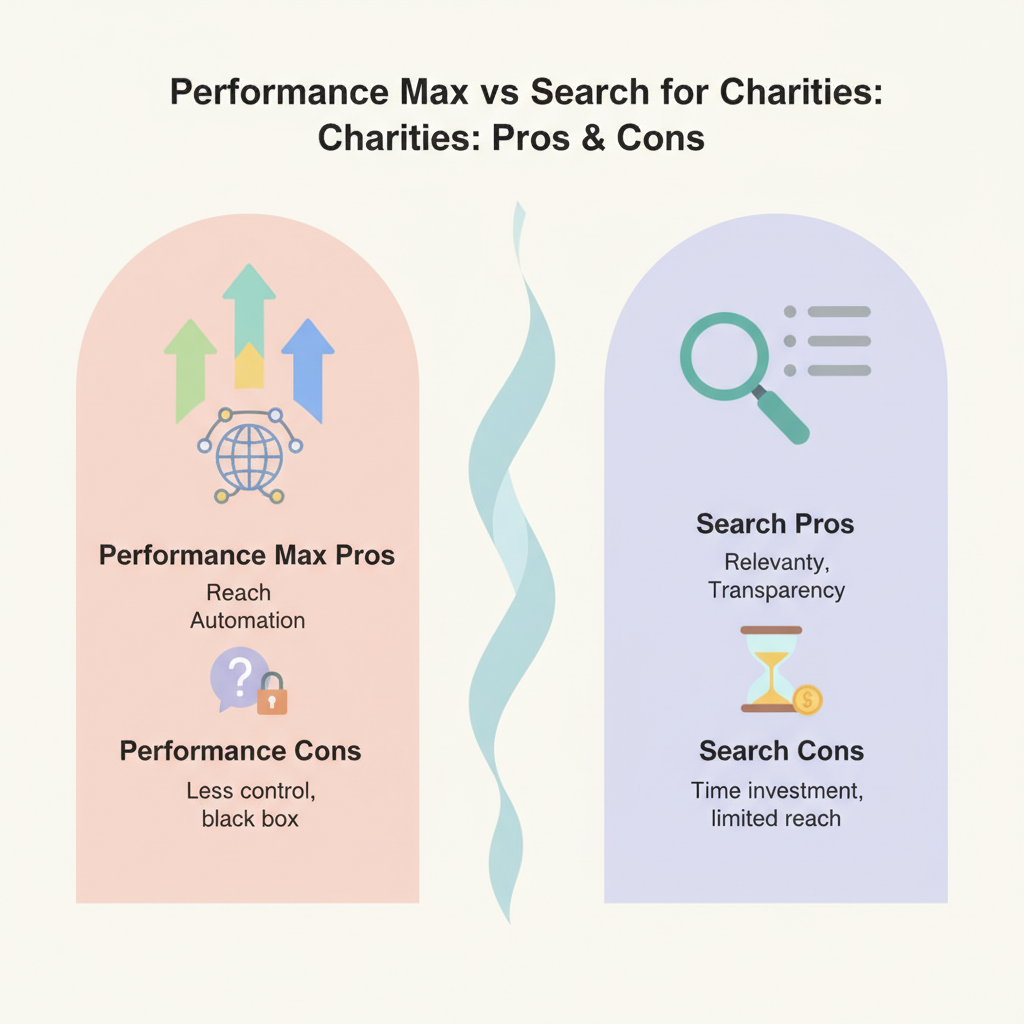
The Pros of Search
- Precision Control: You select the exact keywords you want to bid on. This is crucial for sensitive topics where you want to avoid irrelevant traffic.
- Clear Intent: You can target users at specific stages of the funnel, from “what is food poverty” (Awareness) to “donate to food bank UK” (Action).
- Transparent Reporting: You can see exactly which search terms triggered your ads, allowing for granular optimization.
The Cons of Search
- The Compliance Trap: Standard Search campaigns must maintain a 5% CTR. Failure to do so for two consecutive months can lead to account suspension. This often forces charities to pause lower-performing (but mission-critical) keywords.
- Management Intensity: Maintaining high Quality Scores and pruning low-CTR keywords requires weekly hands-on management.
- Volume Limits: If people aren’t searching for your specific keywords, your budget goes unspent.
Round 2: The Challenger – Performance Max (PMax)
Performance Max uses Google’s AI to automate targeting. Instead of keywords, you provide “Asset Groups” (headlines, descriptions, images) and “Audience Signals” (data about who your donors are). Google then finds users who match that profile.
The Pros of PMax for Charities
- The Compliance Exemption: This is the game-changer. Performance Max campaigns are exempt from the 5% CTR rule. You can run broader, awareness-focused campaigns without fearing account suspension.
- Unlock Google Maps: For local charities—community centres, charity shops, or food banks—PMax is superior. It automatically serves ads on Google Maps to users searching for local services, driving foot traffic and local awareness.
- Fills the Budget Gaps: PMax is excellent at spending the full $10,000 grant by finding relevant search queries that you might have missed in your keyword research.
The Cons of PMax
- The “Black Box”: You get significantly less data on where your ads showed or exactly what search terms triggered them. This can be frustrating for charities needing strict brand safety.
- Asset Hungry: Even though it only runs on Search and Maps for Grants, PMax still performs better when you feed it high-quality data and diverse text assets.
- Conversion Dependency: PMax relies heavily on conversion data. If your website does not have robust tracking for donations, volunteer sign-ups, or newsletter joins, the AI will fail to optimize effectively.
Head-to-Head Comparison Table
| Feature | Search Campaigns | Performance Max (Ad Grants) |
|---|---|---|
| Targeting Method | Manual Keywords | AI & Audience Signals |
| Inventory | Google Search | Google Search + Google Maps |
| CTR Compliance | Must maintain 5%+ | Exempt from 5% rule |
| Control | High (Granular) | Low (Automated) |
| Best For | Specific appeals, high-intent donors | Local awareness, utilizing budget, broad reach |
Strategic Recommendation: The “Power Pairing”
For most UK charities, the question isn’t “Performance Max vs Search,” but rather how to use them together. At Digital for Charities, we recommend a hybrid structure:
1. Core Search for High Intent
Keep your standard Search campaigns for your “money terms”—keywords like “donate to animal charity” or “volunteering London”. You need the precision of Search to ensure you are capturing these high-value users with the perfect ad copy.
2. PMax for Growth & Safety
Launch a Performance Max campaign to capture broader traffic and local Maps visibility. Use this campaign to target looser themes that might have a low CTR (e.g., general educational topics related to your cause). Since PMax is exempt from the 5% rule, it acts as a “safety net,” allowing you to spend more of your grant without risking compliance.
Pro-Tips for 2026 Success
- Fix Your Conversion Tracking: Before launching PMax, ensure your Google Analytics 4 (GA4) conversions are importing correctly into Google Ads. The AI needs to know what a “success” looks like to work for you.
- Use Negative Keywords: You cannot add negative keywords to PMax at the campaign level as easily as Search. You may need to contact Google Support or use an “Account Level” negative keyword list to prevent PMax from cannibalizing your brand terms.
- Leverage First-Party Data: Upload a list of your past donors (hashed for privacy) as an “Audience Signal” in PMax. This tells Google: “Find me more people who look like these people.”
Sources & Methodology
This article was generated by Google Gemini 3 Pro, grounding its insights in the latest 2025/2026 Google Ad Grant policy updates and UK charity sector trends.
Cited Sources:
Try Google Gemini yourself at gemini.google.com.