
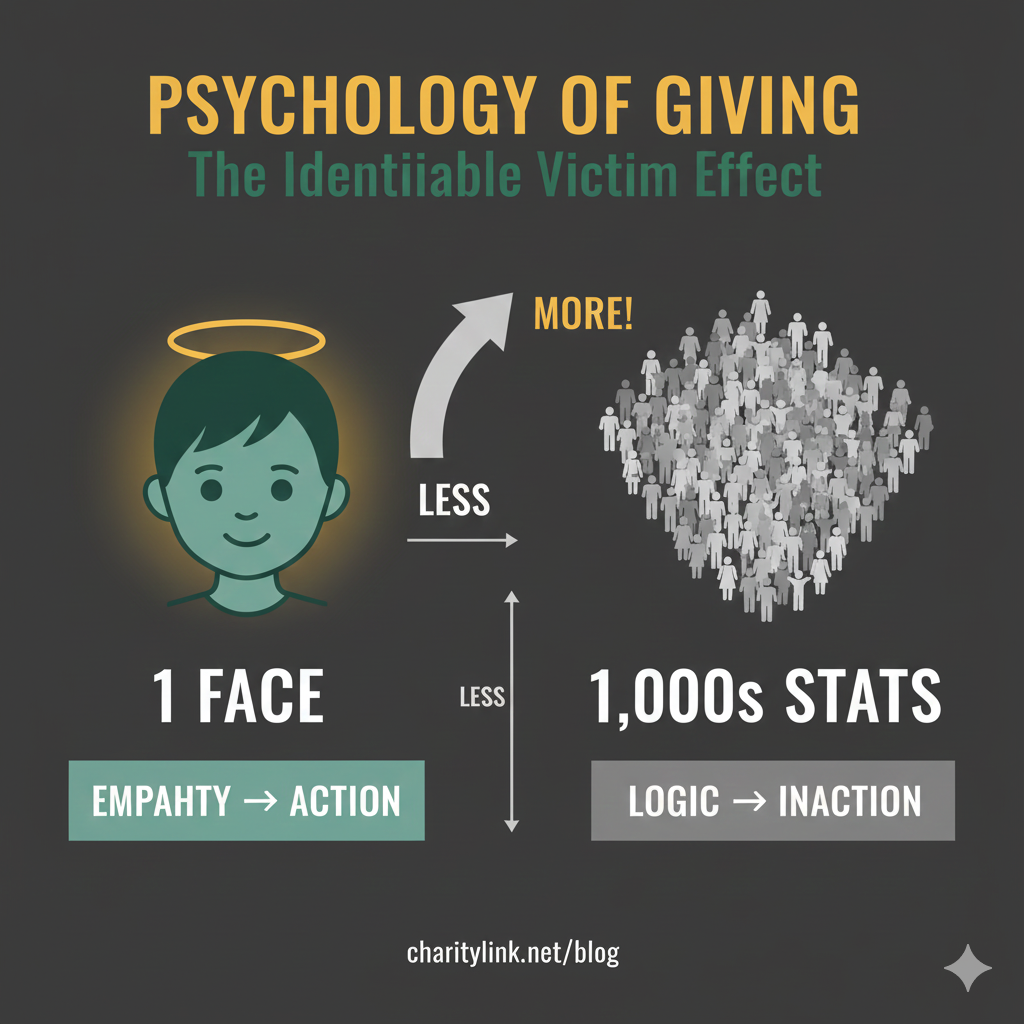
Psychology of Giving: The Identifiable Victim Effect …
THE SCIENCE OF GIVING
Bridging the “Intention-Action Gap” with Behavioral Psychology
Ethical Fundraising
Psychology
Data
The Intention-Action Gap
The biggest challenge in fundraising isn’t a lack of generosity; it’s the disconnect between wanting to give and actually doing it. Behavioral science reveals a stark drop-off between Intention (the desire to help) and Action (completing the donation).
Key Insight:
Humans are “cognitive misers.” Even high motivation can be derailed by minor friction or lack of a specific prompt. The gap represents lost potential for social impact.
Representative data illustrating the typical drop-off in charitable engagement funnels.
Why We Give
Donating isn’t a purely rational economic calculation. It’s an emotional and social act driven by deep psychological needs. Understanding these drivers allows fundraisers to design campaigns that resonate rather than guilt-trip.
- ❤️ Warm Glow Effect
- 🤝 Social Connection
- 🛡️ Identity & Values
The 5 Core Motivators
Relative influence of psychological factors on donation decisions.
Friction vs. Fuel
To bridge the gap, we must minimize Friction (barriers that make giving hard) and maximize Fuel (psychological nudges that encourage action).
FRICTION 🛑
Choice Overload
“Too many funds to choose from…”
Process Complexity
“Why do I need to create an account?”
Unclear Impact
“Where does the money actually go?”
FUEL 🚀
Defaults & Anchoring
Suggesting amounts (e.g., £20) reduces cognitive load.
Goal Proximity
“We are 90% of the way there!” creates urgency.
Social Proof
“Join 5,000 others in your area.”
A The Identifiable Victim Effect
People are more likely to give to a single, relatable individual than to a faceless group (“statistical victims”). Empathy triggers action; statistics trigger analysis.
B The Power of Anchoring
When donors are unsure how much to give, they look for cues. Suggesting higher initial amounts (“Anchors”) significantly increases average donation size without reducing participation.

The Science of Giving: Bridging the Intention-Act [infographic]
The Science of Giving: Bridging the Intention-Action Gap …